Saturday, April 26, 2014

Trickle-Up Economics

Government stimulus directed to businesses such as tax credits and access to low-cost loans create increased wealth at the top end of the economy. Some claim this is the best way to improve the economy since incomes and jobs will flow down as the businesses expand and hire new workers.

From an employment and income perspective, the result tends to be an increase in profits for businesses, increased incomes for those in higher paying/higher skilled jobs, and some incremental “hiring off the top” of the best available talent from the ranks of the unemployed. Those at the other end of the spectrum are left hoping that employment becomes scare enough over time that eventually they might get an offer for some “trickle-down” job in the future.

Unfortunately, the bottom of the labor pool never gets fully utilized. Like the mean bullies picking up teams for a game on the playground and deliberately rejecting the least athletic kids from participating, the monetary and fiscal policy wizards stop their policies well before employment levels are considered “full” out of tragic and mistaken belief that full employment causes unwelcome inflation. In other words, we say to the millions who want employment: "The rest of society needs you to stay unemployed and impoverished in order that the cost of bread and milk for the rest of us doesn’t go up too much."

Meanwhile at the top, the increased profits and wealth is often siphoned off into cash and bond hoards, and funneled into exclusive investments before it can circulate in the economy as spending which would have helped create jobs & incomes for others. The wealth stream dries up long before it trickles down. 

We need to reverse the flow! A job guarantee creates a floor of income and ongoing work for those rejected from the private sector, employs from the bottom of the pool rather than the top, and provides essential income to those currently relying on government benefits and welfare.

Businesses invest in capital and new jobs when there is a prospect for increased sales, not because they get tax breaks. It is a forecast of increased demand that drives investment. Those in a job guarantee program would spend most of their income directly into the economy, creating the necessary demand stimulus for business to have an incentive to hire from the pool. It also stimulates the portions of the economy that best benefit society as a whole (food production, household goods, medical care, etc.), rather than the goods & services that only the elite can afford (like yachts, castles & cosmetic surgery).

Trickle-down economics is a farce. 

Trickle-up economics would provide the kind of buffer the economy needs to maintain a base of demand during downturns, while reducing the personal tragedy of structural unemployment and the ruined communities and social burden left in its wake.

At the core of trickle-up economics is the job guarantee. And don't worry, the top 0.1% will still get their fair share…eventually.

Tuesday, April 22, 2014

Why do we think so wrongly about money?

Words matter.

“Debt” is a word that evokes powerful emotions. When used in association with our government it implies a burden on the people, irresponsibility, fiscal cliffs (whatever that is), sovereign bankruptcy, or worse! The media, blogosphere, and water cooler is rife with such sentiment.

Over forty years ago when some currencies were convertible to gold, national debt DID have meaning. Nations like this (and current European nations that use a currency and do not issue their own currency) have to run trade surpluses to keep reserves of gold (or Euros) or they risk going to the bond market to borrow at rising interest rates. Nations that issue their own currency (US, UK, Japan, Canada, New Zealand, Australia etc.) control the rate they choose to pay those who save their currency. "Debt" is their choice to give savers an interest-earning alternative to reserves. It is NOT the same thing as real debt, and the word keeps us from using our national money to help the economy and maintain full employment.

Debt carries weight and meaning. It affects our perceptions of right and wrong. It fills our minds with worry about the future. 

Debt implies borrowing. We are led to believe that the government has to borrow money from the people. 
It doesn’t.

Borrowing implies someone first had to save that money. We are led to believe that our government takes money from private citizens to spend on people (so-called “transfer payments”) or things, leaving the private sector with less money. 
It doesn’t.

Saved money implies that when the government borrows, money is being “used up” that could be invested in something else. We are led to believe the government “debt” takes away our opportunity to invest in more productive things. 
It doesn’t.

Debt implies a lengthy financial burden. We are led to believe the government must make future generations labor under its weight and suffer lower quality of life until it is all paid back. 

Perhaps we should banish the word “debt” from all discussions of national government money! (Of course debt is still highly relevant to cities, states, households and businesses because we don’t issue our own currency!) National debt is an entirely unhelpful term, terribly misleading to the public, and wreaking havoc in political discourse and public policy.

We can simply say that we do not have national "debt". Any government spending that is not taxed back becomes our savings in the form of currency, bank reserves, and bonds. We get all the benefits of that spending for the common good if we use it well. Let's shift our discussion from debt ceiling despair and deficit hysteria to a more hopeful perspective; how best to use our national money for our current needs and those of the next generation.

Sunday, April 20, 2014

Drawing some initial conclusions

Money is a form of credit created by the government, and it typically becomes the national unit of account for all money things. When that government itself is the creation of the people, we can safely say that our money is of the people and for the people. It’s ours to use for the public good – which is exactly why we created government in the first place!

Stable prices and full employment are the stated mandates of the US Federal Reserve Bank (called the “Dual Mandate”). I believe these to be noble goals but they cannot be realistically achieved via central bank monetary policy (i.e. raising and lowering interest rates and managing bank reserves) for reasons I won’t go into yet, although our experience alone is enough to confirm the validity of this statement. 

However, we can achieve these goals if we use our monetary system to its full extent, and that means we have to use fiscal policy (i.e. government spending and taxation). In particular, the implementation of a job guarantee would provide employment to everyone who can and wants to work, while functioning as a stabilizing buffer stock in the economy (the pool of labor in the program will rise and fall as the economy expands and contracts). More on this in later posts.

So why don’t we? Because we are held back by the mistaken belief that we can’t afford to, or that we can’t spend money that way, or that if we do there will be bad consequences. For the record, there are plenty of bad consequences evident all around us today for NOT doing so!

I have attempted to explain that government money works very differently than how households and businesses are managed. The differences are highly significant and we ignore them at our peril. Failure to use the system properly does more harm than good.

What have we learned?
  • Taxation and bond sales do not finance government spending, and governments have no need to balance revenues versus their spending.
  • Taxation plays a very different role in the economy than the mistaken notion that it is used for funding government; we need to use taxation appropriately.
  • Government “debt” is really just money the rest of us have saved (or we can also say it is money that the government has spent into the economy but not yet taxed back out, so we get to save it). As such, this so-called "debt" is not to be feared and there is never a need for government to have to earn more (i.e. increases taxes) in order to pay it off.
  • The hyperinflation monster we have been taught to fear lives in a different monetary system than ours. It lurks in the world of societal destruction combined with gold standards, pegged currencies, external currencies, or foreign denominated national debts.
  • In short, we can afford to do what is in our best interest.
So how should we best use the people’s money for public purpose? We can certainly have legitimate debate over the “what” and the “how” (indeed, this is exactly what our politicians should be doing), but for now let’s just imagine some possibilities now that the blinders are lifted off:
  • We can afford to provide housing, food, and care for our elderly.
  • We can afford to provide education to our youth so they have the skills and knowledge to be productive citizens and future innovators.
  • We can afford to provide essential health services to everyone.
  • We can afford to grow our economy without harming our environment.
  • We can afford to repair our national infrastructure, and to invest in new infrastructure (a national high speed electric rail system linking all major cities?)
  • We can afford to provide employment to everyone who is ready, willing and able to work.
  • We can afford to invest in research and development of groundbreaking science and technology, and to help commercialize innovative technologies.
  • We can afford to cut income taxes and increase the real incomes of families.
  • We can afford to help struggling municipalities and states and not let their citizens suffer the loss of essential services because of mismanagement of some previous politicians.
Lest you misunderstand the message, let me emphasize that 1) just because we can afford something it does not mean that everything is an appropriate use of public money, and 2) there is a big distinction between the public’s money being used to pay for something and government employees doing or managing that activity (the two do not have to go together). For example, there are ways to provide health care for every citizen without a government run medical industry if that is what the people prefer. 
  
J Fagg Foster, Denver University Economics Professor, wrote in 1966.
Whatever is technically feasible is financially possible. To the perpetual question ‘Where is the money coming from?’ the answer is now clear. It comes from the only two institutions we permit to create money funds: the treasury of the sovereign government and commercial banks. And the rate at which we permit either to create funds is pretty much a matter of public policy.” (emphasis added)
Of course we have to consider the effect of what we do on the economy (i.e. it would almost certainly cause inflation if we decided to give every citizen one million dollars in cash tomorrow), but the key point is that affordability is never the issue for the government (i.e. "us acting collectively for the common good"). We have unlimited ability to credit bank accounts if we direct the government to do so.


After too many years of economic malaise, isn't it time to begin to see and act rightly? We have an incredible system of money and government that was formed for our benefit. Let’s use it. Start to imagine a prosperous and just future for all. It is within our reach. 

Sunday, April 13, 2014

Money Myth 10: Persistent government deficits lead to high inflation.


FACT: There is simply no evidence that increases in the money supply and/or government "debt" cause hyperinflation. The propensity to save and a nation's underutilized productive capacity are two major mitigating factors to inflation.

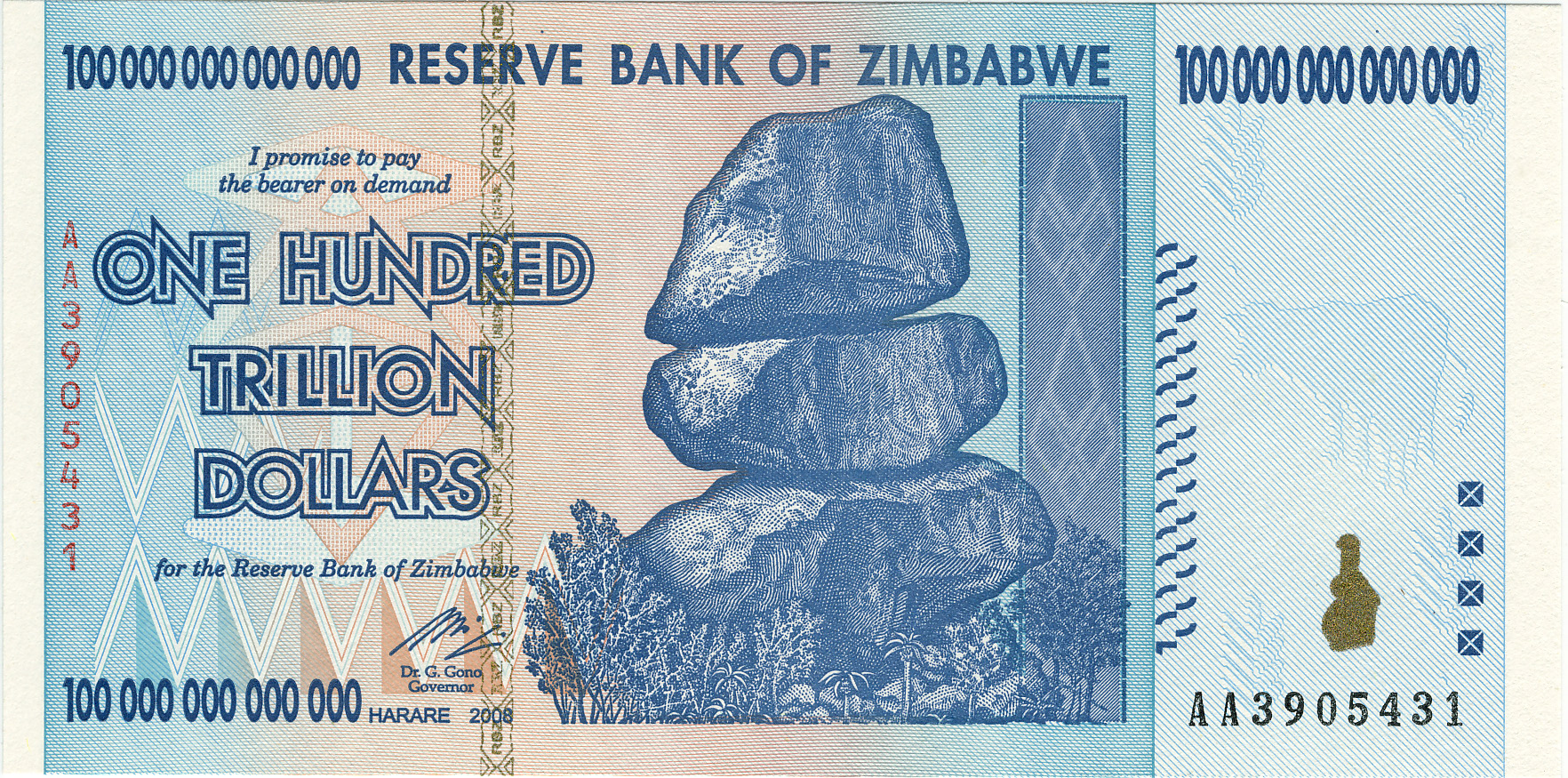
The fear of hyperinflation (especially in the US) is a common theme behind the many "doom & gloom" authors, precious metal fund promoters, and other economists and investor newsletters that warn of the next dire economic crisis caused by too much government debt. The story usually goes that the US debt is reaching crisis proportions, and that we are one tragic financial crash away from the hyperinflation experience of Zimbabwe, Wiemar Republic, or more recently, Greece.

It should be clear by now that the currency of nations like the US function very differently than those of nations that don't issue their own currency (e.g. the Euro), peg to another currency (e.g. some countries promise to convert their currency on demand to the US dollar), promise to redeem in gold, or hold significant foreign currency-denominated debt. It was these factors that gave rise to hyperinflation in Zimbabwe and the Wiemar Republic, along with the destruction of those nations' productive capacity. In other words, they had promised to meet financial obligations in a currency they did not issue, and with the productive capability of their countries decimated, they had no ability to produce enough surplus to meet those obligations. The conditions for hyperinflation are extraordinary factors (often external) such as war, civil war, foreign denominated debt or other significant external obligations, or rampant corruption.

Inflation is a complex subject and there is no doubt that the fear of inflation has a significant influence on consumer and business confidence. Inflation is hard to measure since innovation and productivity gains make direct comparisons between products we use today and those of the past quite difficult. This, among other factors, has led to much debate (and mistrust) over the government methodology for calculating inflation-tracking statistics such as CPI. However, it is still reasonable to take the position that inflation has been consistently low for many years in many countries, despite consistent and even significant deficit spending. 

Too much inflation can certainly reduce the desirability of a currency for savers, and can have a disproportionate negative impact on the poor since a higher percentage of their income is spent on life's essentials. This is one of the areas where our monetary system, once properly understood, can be used for the public good (mitigating inflation's effects on the poor, promoting employment, and using tax increases only when necessary to cool a frothy economy.

So with this background, we can make some general comments about inflation.
  • For better or worse, modern economies seek to maintain a constant low level of inflation. This is generally viewed as positive in order to attract continued investment (deflation tends to cause the private sector to retract and stop investing since they can't see how new investment will produce financial returns).
  • Any inflation has its drawbacks and we should consider how to mitigate the impact on the poor in public policy and fiscal policy.
  • The job guarantee provides a framework for using employed labor as a buffer stock and a price control mechanism that would bring price stability with full employment. 
  • Inflation is NOT caused automatically by an increase in money supply. This dynamic has been evident in Japan for about two decades.
  • The conditions for hyperinflation do NOT exist in the US or other countries with a similar monetary system, and history seems to have borne out this distinction. 
  • We may see continued asset and commodity price inflation as investors chase yield. This dynamic has much to do with our financialized economy and the structural & tax incentives for pooling wealth under the control of the financial sector.
  • If the private and public sector desire to save and hold government securities at least equal to deficits and trade balances (which is very much the case with the US and many other developed countries today), the "not-yet-taxed government spending" (deficits) do not result in a rising rate of inflation. 
  • When a nation has high unemployment and its productive capacity is below maximum output, inflation is a very low risk as increases in deficit spending are absorbed by expanded output, hiring, etc.
  • There is little evidence that inflation levels higher than what we typically experience (even double digit inflation rates) cause significant negative economic effects. Unfortunately, our fear of inflation has kept us from implementing the very policies that could help those in need the most. Read chapter 7 in Modern Monetary Theory, and this Levy Institute working paper for a more detailed treatment of this topic.
  • If full employment is reached, the economy is booming, and the rate of inflation truly does start to increase above a desired level, higher targeted taxation is an appropriate fiscal policy move (the government removes excess money from the economy, cooling demand).
In conclusion, the fear of hyperinflation is unfounded and is causing much harm. Refusal to increase deficit spending when it is needed the most leaves millions unemployed, perpetuating deficits as the economy languishes, tax receipts fall, and the government safety nets fill up.

We can and we should direct our elected officials to end unemployment now. 

Additional reading

Rob Parenteau has provided an excellent succinct summary of the unique dynamics of hyperinflation, showing why extreme conditions must exist in both demand and supply.

Also read Mythologies: Money and Hyperinflation by Arun DuBois.

Check out the series of posts on the topic by Cullen Roche of Pragmatic Capitalism, especially Hyperinflation - It's More Than Just A Monetary Phenomenon

Bill Mitchell's billy blog has a thorough overview of inflation from the perspective of modern monetary theory in two posts. Part 1 and Part 2

Saturday, April 12, 2014

What I am NOT saying...

This blog is about understanding how our monetary system actually works. Not how we wish it would work. Not how some best-selling “next-big-market-crash” author says it works. Not how the gold exchanges want it to work. Not how the Tea Party, Republican Party or Democratic Party thinks it works.

The myths and facts I have laid out can be verified by those who know the inner workings of the Treasury, the Federal Reserve Bank, and the banking system. Extensive research has gone into uncovering, explaining, and validating this system (see the links and books on the blog for reference).

This blog is also about choices. It is about options that we did not know about or were taught were harmful.

In our ignorance, we have invented problems and proposed cures that harm our economy and our lives. And we have given the controls to those who use the monetary system for their personal gain, to the detriment of the citizenry. Once we properly understand how our money works we can begin to think how to use it for the good of all, and to hold our elected representatives accountable to do what is right.

I know many of you have been a bit stunned, perplexed, or confused by my recent Money Myths posts. This is to be expected since belief in these myths is quite pervasive. My hope is that I get you thinking…that maybe, just maybe, things are not the way we thought.

I realize that I have left much unsaid – deliberately. Too often we reject ideas before we have thought them through because they appear counter-intuitive. And without a doubt, government monetary systems do appear counter-intuitive at first blush.

Here’s what we’ve covered so far:
  • Taxes do not fund government spending; all government spending is via the creation of new money.
  • The government does not borrow from the private sector to fund deficit spending.
  • The government does not borrow from China or other nations to fund the national “debt”.
  • We are not leaving a debt burden to our children.
  • Fiat money is “backed” by a nation’s authority to tax.
  • The Fed does not print money; it manages interest rates and bank reserves.
  • There’s no such thing as “unfunded liabilities”; the government can always “afford” any monetary obligation such as Social Security.
  • Interest rates are controlled by the Fed; foreign nations or bond investors cannot drive rates higher.
  • Government deficit spending increases the net financial assets of the private sector; it does not take away from private sector financial wealth.

With that said, it is time to give a few clarifying words about what I am NOT saying.
  • I am specifically addressing the operational functions of how a national monetary system like the US or Canada or UK can work. For nations that do not issue their own currency, do not allow that currency to float, peg their currency to gold, or promise to convert it to another currency they do not issue, the principles and options described here may not apply or will be greatly limited.
  • I am not saying that nations cannot (many in fact do) choose to pass laws to put limits on monetary functions (debt ceiling limits, balanced budgets, mandatory Treasury account balances, etc.) that unnecessarily restrict the operational value of the monetary system or render ineffectual its capabilities.
  • I am not describing or advocating for a centrally planned economy, or greater government control over the means of production, but I do support the necessary “rule of law” and appropriate regulatory framework that functioning societies and economies require.
  • I am not saying that taxes are unnecessary or that insufficient taxation is not harmful to the currency (in fact taxation is what drives currency).
  • I am not saying that government spending levels do not matter, and that what the government spends the people’s money on has no economic effect (in fact fiscal policy has been greatly overlooked since we created the Federal Reserve, to our detriment).
  • I am not saying that the more governments spend and the less they tax the better off we are (although as I write this there is a great need for more spending and less taxation).
  • I am not saying that inflation cannot happen if governments spend too much relative to taxation levels, savings desires, and the productive capacity of the country (although we are a long way from this today). 
  • I am not saying that even moderate inflation has no negative effects (hence the need for a job guarantee to provide a floor for those who bear a disproportionate impact of inflation).
  • I am not saying that we will not have another harmful economic crisis (rather that the causes are usually not government debt but private sector excesses).


Finally, I understand (to some degree) the concern many have in inefficient and overreaching government. I see the fear and anger in many online forums. I only suggest that we do what our representative system was design for… understand first what needs to be done, and then collectively let’s change it. 

The good news is that there really is a clear and hopeful path forward. 

Additional reading

Check out the Levy Institute paper Modern Money Theory 101: A Reply to Critics by Éric Tymoigne and L. Randall Wray.

Time for a quiz!

To see who has been paying attention, let's have a little quiz. This is from a presentation given by UMKC professor Randall Wray in 2012. See the full presentation below or click here.

True or False?

  1. Just like a household, a government has to finance its spending out of its income or through borrowing.
  2. The role of taxes is to provide finance for government spending.
  3. The National Government borrows money from the private sector to finance the budget deficit.
  4. By running budget surpluses the government takes pressure off interest rates because funds are then available for private sector investment projects.
  5. Persistent budget deficits will burden future generations with inflation and higher taxes.
  6. Running budget surpluses now will help build up the funds necessary to cope with the ageing population in the future.


Friday, April 11, 2014

News is spreading ...

PBS explains how taxes empower money, but does not fund government spending. A useful comparison to Bitcoin and cryptocurrency also.